Put the screens away: The U.S. spent $30 Billion to replace textbooks with screens. The Result: A first generation mentally weaker than its parents.. For the first time in modern history, a generation scores lower than the one that raised it. The reason sits on every school desk in America. Nearly two-thirds of laptop time goes off task
Made-in-Chennai: Royal Enfield beats Ferrari, Audi to become world's third strongest automotive brand. . . . Brings serious vintage style with a modern 650 twin engine
Biogas could be LPG hedge in India's dairy belt: If all the 40 million cattle-rearing households were to shift to biogas, the displacement potential is up to ~4 million tonnes of LPG every year. Even if 10 million of them make this transition, it could save up to Rs 2,000 crore annually
Burden of BikAss: India’s legendary hill towns are sinking. Over development threatens many Himalayan states
India has 100/100 hottest cities in the world: Cutting trees, filling lakes, and building heat traps in the name of BikAss. "The central government is selling geological vital forest land to corporations. Then they are planting irrelevant trees in irrelevant areas to keep the statistics levelled. Not only that but the factories here run completely without regulations"
"Too bad the mangroves on the west coast, trees on the Aravali hills on the western front of India, the sparse protections it has from the warm winds from the direction of Africa, are going away in the name of "progress" and "infrastructure". Capitalism will absolutely be the death of the human race".
Who runs India?: China is run by engineers.. US run by lawyers.. Who runs India?
Highly recommended book. Along similar lines is my analysis: China is run by engineers US run by lawyers Europe by ideologue Pak run by terrorists Who runs India?
What could possibly go wrong: The Pentagon announces AI deals with OpenAI, Google, Microsoft, Amazon, Nvidia, and more — LLMs to be deployed on classified Department of War networks ‘for lawful operational use’
For Korean companies, India is a lucrative cash cow: LG India reported revenue of Rs 24,366 crore and a net profit of Rs 2,203 crore last year. Royalty payments to its Korean parent reached Rs 454.61 crore. But the real headline came with its 2025 IPO: In one stroke, LG India’s market capitalisation surpassed that of its global headquarters’. And it was purely due to generous policy environment.
Hyundai Motor India and its sibling Kia tell a similar tale of extraction masked as investment. Royalty payments stand at 3.5% of sales revenue, translating into thousands of crores annually repatriated to Seoul. Such an anomaly has left Tata Motors and Mahindra to fight an uphill battle against what many term subsidized Korean pricing power.
Samsung India completes the triumvirate of value extractors. Its revenue for the first time crossed Rs 1.11 lakh crore during 2025, making it the only consumer-electronics firm in India to cross the trillion-rupee mark. During 2024, royalty remittances to the Korean parent hit Rs 3,322 crore, roughly 40% of that year’s net profit. Retained earnings have ballooned and been diverted to Vietnam.
Profits earned from Indian consumers through high royalties, IPO cash-outs and dividend flows are effectively subsidizing Vietnamese factories that then export finished goods back into India. Why? Should Korean conglomerates plough cash extracted from India into manufacturing facilities in a smaller neighbor that then undercuts Indian industry? The optics is toxic: India as a lucrative cash cow, Vietnam as the preferred factory floor.
Decades of liberalization were sold on the promise that FDI would catalyze domestic industry, transfer technology and create balanced growth. Instead, the policy has tilted towards foreign giants who repatriate profits, royalties, special dividends and IPO proceeds liberally.
On the other hand, Indian firms struggle with higher compliance costs, delayed approvals, and a royalty burden that starves local innovation.
Part of what pushed this into the open is what Korean firms did here in the last year.
Hyundai and LG listed their Indian arms and between them sent about $4.7 billion back to Seoul through IPOs and special dividends. Samsung's royalty payments to its parent tripled. All within… pic.twitter.com/e2Nbsuxew6
Draining the economy: The proof is in the math: In just the last 12 months, Hyundai and LG repatriated $4.7 billion in royalties and profits. That is nearly ₹40,000 crore leaving our economy.
Localization of parts is not the same as localization of value. You can source 85% of a car’s weight (steel, rubber, glass) in India, but if the Intellectual Property (IP), engine architecture, and software ownership sit in Seoul, the wealth generated by Indian labor and…
Funding the Adversary: India’s trade deficit with China has nearly tripled since Modi took office. Bankrolling China's rise which in turn lays claim to vast Indian territories including an entire state.
Trump kissing Xi Jinping's ass: A quiet U.S. favor for Xi Jinping.. A U.S. quota increase at the IMF would rescue China’s bad loans.
Trump is scheduled to visit Beijing in May for a summit with Xi, and he will come bearing at least one surprising gift: A budget request to Congress to hand more money to Mr. Xi’s friends at the IMF.
Chinese satellites over Mideast battlefield put US on edge: Chinese AI company MizarVision claimed on social media to have tracked the movements of American aircraft carriers, F-22 stealth fighters and B-52 bombers by using AI to analyze satellite data.
Microwave weapon: 20-gigawatt Chinese microwave weapon touted as ‘Starlink’s worst nightmare’ by country's media — portable 5-ton device can deliver full-minute destructive bursts
Lesson for India, the GREAT consumer of imported tech: Iran claims US exploited networking equipment backdoors during strikes — says devices from Cisco and others failed despite blackout in attack that 'indicates deep sabotage'
Privacy risk: Google Chrome lacks protection against one of the most basic and common ways to track users online
Rami Reddy found that a parcel of his family land, which had been temporarily given to a distant relative for use as a cattle shed, had allegedly been converted into a Christian prayer hall. The relative had converted to Christianity and changed the site into a place of worship.
India the big loser in the US-Iran War: At the core the issue is of India being strung out between strategic subservience to the US — that has led to its Gulf policy ending in a cul de sac, and economic dependence on China, with both Washington and Beijing now hanging Modi-Jaishankar and India out to dry.
"Washington will strive to keep India down, preferably under its thumb, economically and in the technology sphere, prop up Pakistan as its main agent in the region, but will expect Delhi to help the US counterpoise China in the Indo-Pacific! The Indian govt is sufficiently spooked by the China threat to want to rely on the US strategically and to do so on American terms. And sure India should arm itself with American weapons, and reproduce any US military goods it wants but under license, thus lighting fire to the atmnirbharta pyre".
🇫🇷🇮🇳 France just drew a hard line… and it hits India’s airpower strategy directly.
Paris is refusing> to give India access to Rafale’s core source codes, which means New Delhi cannot independently modify the jet’s most critical systems, including its radar, mission computer, and… https://t.co/YJ3H46rst0pic.twitter.com/0Nl22cWZa7
The UAE has withdrawn from funding the development of the new Rafale F5 after France refused to transfer advanced technology. The message is clear: Real partnership with genuine technology transfer — or no deal. pic.twitter.com/MUTheN8DHB
— سيف الدرعي| Saif alderei (@saif_aldareei) April 3, 2026
🇨🇳 Chinese civilians with technical backgrounds are increasingly posting detailed military analysis online aimed at helping Iran counter U.S. forces, in a growing grassroots trend across Chinese social media, according to the South China Morning Post.
Protein myths: “There is no evidence that habitual exercise increases protein requirements; indeed protein metabolism may become more efficient as a result of training.” ..just because it’s post workout, doesn’t mean you need oodles of whey
Bike Bus: "One of the benefits of the bike bus is that when you're cycling as a group you feel a bit safer.
"There's been a lovely buzz watching the bike bus arrive each week and the children who participated have been really happy, enthusiastic, really energised by their bike ride here to school".
"I think it's great for kids mental health as well as their physical health plus I think it's great for parents too.
"I think for the community more broadly too because there's less cars on the road, less congestion, it's better air quality, so there's a lot of benefits."
Solar is winning the energy race: The world's cheapest power source is scaling at warp speed, pushing coal, gas and nuclear aside. In 2015, Pakistan and South Africa each produced less than 1% of their electricity from solar. Ten years later, that has risen to 20% and 10% respectively.
'The myth about SIPs': At the end of the day, in order for me to win, someone else must lose. Now, in order to create that population of losers, you need the millions of retail investors, the millions of SIP participants, for their capital to flow somewhere.
Showing some spine: Malaysia exits US reciprocal trade deal. Becomes the first country to abandon a pact negotiated under Washington’s reciprocal tariff strategy after a court ruling removed the legal basis for the policy.
End of Bitcoin? Google research suggests encryption technique used by Bitcoin will be cracked by quantum computers around 2029 — search giant says quantum attacks need to be prepared for now
Google unveils TurboQuant, a new AI memory compression algorithm — and yes, the internet is calling it 'Pied Piper'. . . A simple explanation of the key idea behind TurboQuant
It is all getting embarrassing. In December a cricket match between India and South Africa was called off because smog made it impossible to see the ball. In January one the world’s top badminton players pulled out of the India Open in Delhi citing the bad air (and getting a $5,000 fine). Those who did play sent an official complaint to International Olympic Committee.
The Price of Intelligence is CollapsingOne developer with Claude Code can now do what took a team a month. The cost of Claude Pro or ChatGPT is $20 dollars a month, while a Max subscription is $200 dollars. The median US knowledge worker costs ~350-500 dollars a day fully loaded. An agent that handles even a fraction of their workflow a day at ~6-7 dollars is a 10-30x RoI not including improvement in intelligence.
The cost collapse is destroying the seat-based software model. There has been no bigger share shift than Microsoft’s seat-based Office 365. Most of the cash today still comes from Office. The core way of how a human interacts with a computer is about to change, and Microsoft sits at the center of the old paradigm.
Why does a company need to standardize Salesforce if an agent is just going to query data on leads on your behalf? Salesforce is a form and workflow wrapper, and the form and workflow can likely be scaffolded by AI into a database and then queried as needed.
AI fears wipe out $50 billion from Indian IT stocks. . . Software ate the world. AI is eating software.
Dr Vishal Sikka: At a time when there was no ChatGPT, Gemini, or self-driving cars, Vishal Sikka gave a presentation on AI before NITI Aayog at the PM’s request, where officials of 20 Union Ministries were gathered. . . India's risk-averse capitalism has no place people like him
"India Has a Great Opportunity in AI, Period" – Dr. Vishal Sikka (Ex-Infosys)
1. TCS has partnered with him to fight its existential crisis
2. PM & officials have met him multiple times
3. Oracle, GSK, BMW, Stanford have him on their Boards for AI
Existential threat: The EU should consider either an unprecedented 30% across-the-board tariff on Chinese goods or a 30% depreciation of the euro against the renminbi to counter a flood of cheap imports, according to a French govt strategy report.
China is depleting the world's oceans of fish. Estimates are between 200,000 - 800,000 fishing vessels, going as far as Argentina.
They account for ~half of the world's fishing catch and do not respect stewardship protocols to preserve ecosystems. This is not industrial… pic.twitter.com/BfbJoGTveM
The SaaS -Pocalypse Has Begun: For most of the past two decades, enterprise software benefited from a remarkably stable economic story. Software was expensive to build. Switching costs were high. Data lived in proprietary systems.
Once a platform became the system of record, it stayed there. Recurring revenue was treated as a proxy for predictability. Contracts were assumed to be sticky. Cash flows were assumed to be resilient.
AI is now testing every part of that logic at once.
AI doesn't kill the software directly. It kills the headcount that uses the software. Which kills the per-seat revenue model. Which kills the business... "Software becomes a commodity; AI becomes the "brain" and the worker".
Satya Nadela is basically describing the death of the traditional SaaS model.
Explains the AI agentic future, and where the "value" lives.
Because business logic is moving from the software application to the AI agents.
Anthropic's new AI tools disrupts data analytics and software companies: AI developer Anthropic launched plug-ins for its Claude Cowork agent that would automate tasks across legal, sales, marketing and data analysis. That move has sparked worries of an impending AI-fueled disruption of the data and professional services industry, which were once seen as major beneficiaries of the AI era.
Goldman Sachs is rolling out Anthropic’s AI model to automate accounting and compliance roles completely.
Anthropic engineers have been embedded at Goldman for 6 months, co-developing systems that act like “digital co-workers” for high-volume, process-heavy tasks.
India's staffing-intensive IT sector shaken: "As Indian enterprises integrate Claude for critical coding workflows, dependency on large vendor teams may decline, squeezing billable hours and margins. Anthropic’s advanced AI systems also threaten entry‑level talent pool at Indian IT firms by replacing routine development and testing tasks".
Anything but Deep Tech: Indian corporate investment is characterised by low R&D intensity and concentration in real estate-linked, regulated, or quasi-monopolistic sectors with a relative lack of willingness and appetite to invest towards long-term risk absorption and become globally competitive.
A 'Greater Balochistan'?There is growing trepidation in Pakistan establishment circles that there could be a new great game underway in the region to create a Greater Balochistan comprising Sistan-Baluchistan and Balochistan. This is not just a mineral-rich area, but geographically, a very pivotal area.
A Greater Balochistan will alter the geopolitics of the region, straddling not only the entire Gulf region but also providing a base to access Central Asia and keep a watch over troublesome areas in Iran, Afghanistan and a rump Pakistan. In fact, the geographical relevance that Pakistan keeps talking about comes from its control over Balochistan.
The Pakistanis are losing sleep at the thought of powerful regional and global players waking up to the importance of Balochistan. Operation Herof 2 and the larger Baloch uprising are, therefore, no longer being seen as a local separatist movement but as part of a larger global conspiracy to cut not just Iran but also Pakistan to size.
The United States did not merely abandon the Kurds it handed them over to terror, to knives, to silence. Allies were turned into expendable bodies. Promises were buried alongside the dead. I am a Dutch journalist, and I refuse to look away. I feel the pain of the Kurdish people… pic.twitter.com/u5PYTJdbqD
Why Indian cities are hostile to pedestrians: Annual pedestrian deaths on Indian roads exceed fatalities reported in several active conflict zones globally, underscoring that Indian streets function as a daily warzone for walkers... “Attempts to redesign roads without prioritising pedestrians are a fundamental part of the problem. Footpaths are a default globally, not here.”
Win for American farmer: New US-India deal will export more American farm products to India's massive market, lifting prices, and pumping cash into rural America.
Thank you @POTUS for ONCE AGAIN delivering for our American farmers.
New US-India deal will export more American farm products to India's massive market, lifting prices, and pumping cash into rural America.
World University Rankings 2026: China shows remarkable progress. Apart from IISc, no other Indian university managed to secure a top 100 position in any subject area.
THE Subject Rankings 2026: While the US and UK institutions clinched the top ranks, China showed increasing strength, bagging seven top 10 positions across subjects. . . . . How India is failing its educated youth.
'Vishwaguru' is nowhere: From Malaysia to Germany: 10 countries where international students are heading beyond the Big Four... India continues to lag behind Asian peers such as China, Hong Kong and South Korea, Japan and Singapore in research-related performance.
Harvard is number one for Engineering in our latest subject rankings, thanks to its outstanding research environment.
Why the tech world thinks the American dream is dying: The argument is that tech companies (and their leaders) will become a class unto their own with infinite wealth. No one else will have the means to generate money for themselves because AI will have taken their jobs and opportunities.
How ASML Conquered The Chip World: Extreme Ultraviolet Lithography - the insane machines that make the most advanced computer chips.
With TACO help: Chinese EVs blow past Tesla and tariffs en route to global reign... Another record month for EV sales in China!. . . As Trump talks tariffs, his Argentine ally welcomes a first shipload of Chinese EVs
Erdogan is no Modi: Turkey now buys more Russian oil than India. . . . . RM: "There is no morality or friendship factor, regardless of verbal praise or hugs. Only pragmatic self interest. Hello India! The battlefield is not emotional feel good victories in social media".
TRUMP’S ALGORITHM AND INDIA: 1. There is no morality or friendship factor, regardless of verbal praise or hugs. Only pragmatic self interest. Hard Realism. Soft power is irrelevant. 2. Policy driven by MAGA base & CIA. 3. Desire to “change history” using hypermasculinity. 4. USA…
UK considering social media ban for under 16s: The world's first social media ban for young people took effect in Australia in December 2025, prompting other countries, including the UK, to consider following suit.
Is avoiding carbs and sugar the key to a healthy old age?
No, the secret to longevity is NOT skipping carbs. Let's see what the actual data says: the world's longest-living groups (Okinawa, Sardinia, Ikaria, Nicoya, Loma Linda) eat a great amount of carbs.
Okinawans previously ate 85% carbs, and sweet potatoes and rice were their main source. Sardinians eat sourdough bread daily. These people are turning 100+ years old eating carbs in every single meal.
The key isn't eliminating carbs - it's eliminating processed garbage. Sugar? Yes, added sugar is something to avoid.
When Dry January becomes permanent: ‘Even though I was fit and energetic the weekends were gone’. “You’d have few drinks on Friday night because you’ve worked hard all week long, and then Saturday was sluggish. You might have a few drinks on Saturday night, and Sunday was sluggish. All of a sudden it’s Monday.”
Ugly, smog filled 'bikAss' comes with a price: India is seeing dip in foreign tourists. In contrast, Vietnam became the fastest growing market for foreign tourist arrivals in south east Asia
What urban India needs: Walkaluru walkathon highlights Bengaluru’s pedestrian infrastructure, encourages walking culture
Indore tragedy: Indore, in spotlight over 20 deaths, allocated Rs 2,450 Crore for 'Clean' Water. What makes the tragedy even more disturbing is the scale of public money that has been spent on Indore's water and sanitation infrastructure over the past five years.
60% of top 1,000 stocks delivered negative returns in 2025: Even after the recent correction, the Nifty Smallcap 100 trades at a price-to-earnings multiple of 24.6 based on one-year forward earnings, well above its 10-year average of 18.3.
Why The Americans Were Opposed To Agni: 'The heat shield technology for re-entry vehicles was first mastered in DRDO for the Agni missile.' 'This is why the Americans were so opposed to Agni in the 1980s, unlike other missiles -- it was a re-entry vehicle.'
The Chinese way: Videos and photographs show how the Chinese authorities have tried to dismantle Zion Church, a Christian network with branches across the country.
The year of Chinese robotics domination: The real AI story of 2026 will be found in the boring, the mundane—and in China. Washington's fatal miscalculation was assuming its sanctions would hammer Chinese innovation. Instead, it only hampered the viability of the West's own tech.
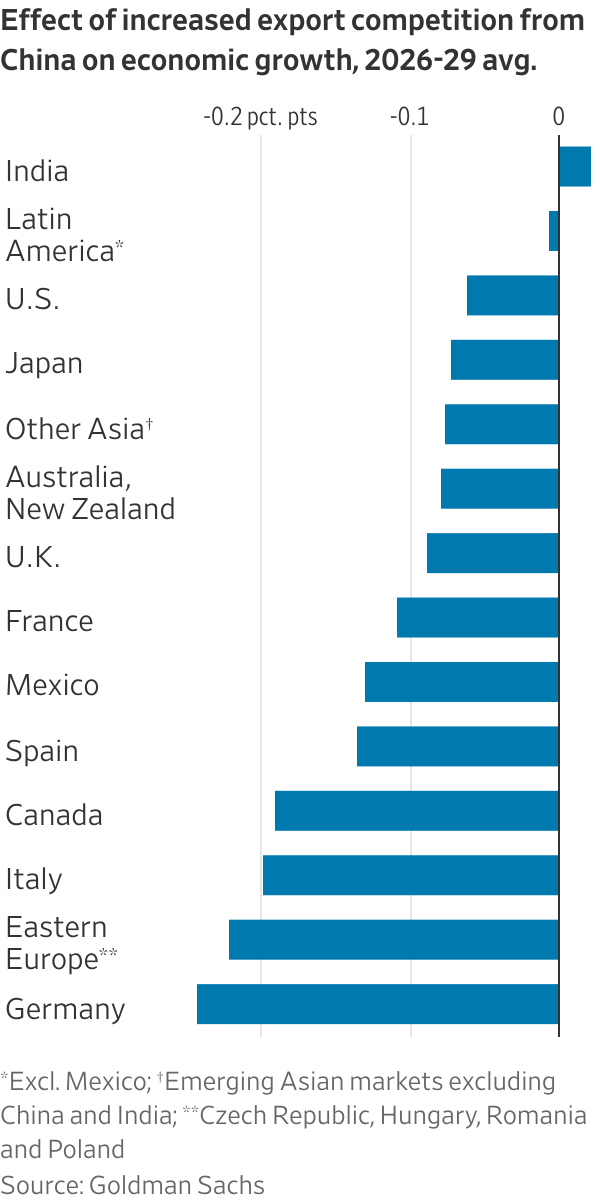
The most effective way to turn back China’s export onslaught would be for the U.S. to coordinate with like-minded partners. Trump has to date shown no interest in such a united front.
Canada last year copied the U.S.’s 100% tariffs on Chinese EVs. Then Trump hit Canada with auto tariffs, and China retaliated against Canadian agriculture. Caught in a two-front trade war, Canada is reviewing its tariffs on China. . . . Trump is a blessing for CCP. . . Why China’s trade surplus just keeps growing.
Automobile superpower: China beats Toyota at its own hybrid car game with 48% gas engine efficiency record
AI superpower: U.S. Investors are going big on China AI despite concerns in Congress
Silicon Valley has spent mountains of money in pursuit of AI’s holy grail: AGI. Enthusiasts say it will give the U.S. insurmountable military advantages, help cure cancer and solve climate change, and eliminate the need for people to perform routine work such as accounting and customer service.
In China, by contrast, leader Xi Jinping has recently had little to say about AGI. Instead, he is pushing the country’s tech industry to be “strongly oriented toward applications”—building practical, low-cost tools that boost China’s efficiency and can be marketed easily.
China leads research in 90% of crucial technologies — a dramatic shift this century
Deindustrializing Germany: Germany’s industrial might was built on equilibrium cheap Russian energy, Chinese technology partnerships, and an export-driven alliance with global markets. That balance has been obliterated.
Deindustrializing Germany: The Silent Coup of Brussels, Washington & the War Economy
Germany’s collapse is no longer a distant warning it is unfolding in real time on the factory floors of Wolfsburg. Volkswagen, the crown jewel of Europe’s manufacturing prowess, is preparing to…
Swami Vivekananda on China: ‘I see before me the body of an elephant. There is a foal within. But it is a lion-cub that comes out of it. It will grow in future, and China shall become great and powerful.’
KK Mohammed Slams BJP Govt: 'Dark Age for ASI'. "We had done conservation work of around 90 temples there during the Congress period.
But during the 11 years of BJP rule, only 10 temples were restored".
"We learnt a lot from the very first prototype in India": Placing solar panels over the 4,000 miles of California’s open canals could save up to 63 billion gallons of water annually — enough to meet the needs of 2 million people.
This is also how ISRO succeeded -- you can't import a satellite launch vehicle.
In such segments, DRDO and ISRO come out looking very good.
Take for instance, the ring laser gyroscope developed by DRDO under the Integrated Guided Missile Programme.
Older missiles used mechanical gyroscopes; the new laser gyroscope is far more accurate.
Nobody would give that to us, so DRDO developed it indigenously.
However, in areas where an import option exists -- like fighter jets, main battle tanks, or towed artillery guns -- the moment DRDO gets close to a solution, someone shows up offering to sell it.
The sellers also have an interest in undermining DRDO.
There are also numerous critical subsystems developed that aren't as visible.
For example, the heat shield technology for re-entry vehicles was first mastered in DRDO for the Agni missile.
This is why the Americans were so opposed to Agni in the 1980s, unlike other missiles -- it was a re-entry vehicle.
We also had to master the technology of mounting printed circuit boards in these missiles that can withstand extreme shock, vibration, and temperature.
The US had a far better ecosystem for spinning off military technology for civilian use --Teflon came from the space programme.
DRDO could have done this, but it was stifled by financial and ideological hurdles.
For example, armour-penetrating explosives could have had mining and other civilian applications. Similarly the laser gyro, heat shield etc.
The commercialisation never took off because our finance people were scared to make decisions.
I don't necessarily blame them; they fear audit objections. The whole system is messed up.
This is also why government startup funds often go unspent -- no one wants to take the risk inherent in venture capitalism, where you expect many failures for one big success.
This culture of audit objections stifles innovation, and no government, including the present one, has shown the willingness to truly understand and fix this problem.
Our biggest success was the control law for the LCA.
It started around 1992. Girish Deodhare, who just retired as DG of ADA, was my PhD student at Waterloo and joined CAIR.
Dr Kota Harinarayana was the programme director of ADA.
Initially, Martin Marietta was supposed to design the control software. They would talk big but belittle Indian capabilities and refused to share design documents, only giving final numbers.
Dr Kalam, who took over as DG in July '92, called a meeting -- on a Sunday -- and appointed Prof Roddam Narasimha FRS, to head a committee to decide if we could build the control law indigenously. We all said we could.
These foreign companies weren't impressive technically and weren't offering a knowledge transfer.
We decided to go for a state-of-the-art digital fly-by-wire control with a 32-bit floating-point processor, which was advanced for the time.
Prof Narasimha recommended we do it ourselves, and Dr Kalam agreed. He appointed Professor I G Sharma of IISc as an independent assessor to report to the ADA governing council every three months.
We designed the first cut of the control law in about two years.
A major hurdle was computing power. Due to international restrictions, we couldn't get powerful computers in India.
We rented time on a British Aerospace flight simulator in the UK.
Our team would go there with the software on tapes, and our test pilots would fly the LCA control law on that simulator.
Interestingly, the BAE guys, who were also working on the Eurofighter, invited our pilots to try their simulator.
Our pilots later reported that they found the LCA's handling qualities to be better!
Professor M Vidyasagar, FRS, is a Distinguished Professor at IIT Hyderabad. He earned his BS, MS, and PhD in electrical engineering from the University of Wisconsin.
Blue skies are a luxury in India: It’s the same endless blue dome that stretches over America, Europe, and India alike. But it’s not blue anymore in most Indian cities. The saddest part? We got used to it.
Ram mandir needs trees and water bodies to be the model temple of the maryada purushothaman
I feel a tad bit sad every time I go outside the country. In Vietnam now. Lots of parks, used by the elderly for exercise and socializing. Lots of bicycles on the roads. We could have all this and more if only we could root out corruption and develop civic sense in India. https://t.co/Lb0rNBVSzfpic.twitter.com/ggQVOWAxYT
— Vishnu Sreekumar (@vishnusreekumar@masto.ai) (@vishnusreekr) October 24, 2025
Prof Bharat Karnad: Modi’s atmnirbharta policies are cementing India’s reputation as a classic sucker.
“In a move that could severely undercut India’s domestic defence industry, the Modi govt is considering allowing wholly owned local subsidiaries of foreign original equipment manufacturers (OEMs) to qualify as ‘Indian vendors’ in defence procurement. This long-pending demand of multinational arms makers threatens to hand the lucrative defence market to global giants while sidelining homegrown firms.”
That Modi cannot distinguish between “Made in India” — where the entire weapon system is designed, developed, and produced in the country, and “Make in India” where any foreign goods can be imported in disaggregated kit-form and screw-drivered, was pointed out by me when the PM first started talking about atmnirbharta. 11 years later we know what that means.
Modi publicly disclosed what he meant by atm nirbhar — his “Make in India” policy, he said, involves “Indian toil”. So, for the PM it is enough that Indians employed in these Indian factories of foreign arms companies, being set up here in the hope of getting the exact bonanza they are getting now, will be screwdrivering vintage second rate military hardware. But, this policy wrinkle will simplify procurement by bypassing the “jhanjat” of tech transfer. Welcome to India — the dumping ground for antique Western weaponry!
But this development seems in the mainstream of the Modi government’s recent initiatives that see nothing wrong in signing Free Trade Agreements left and right drawn up by that shortsighted commerce minister, Piyush Goel, and his bunch of babus, with provisions in them to permit British and European companies to bid for all Indian govt procurement contracts at the central, state and local levels worth $750 billion annually, which will void the Indian industry.
There are other provisions in them that will bar Indian entities from demanding the transfer of source codes as part of sales deals to enable the re-engineering, say, of weapons and other systems for retrofitment on imported hardware and weapons platforms, to fit India’s needs and requirements.
Hence, Dassault Avions’ refusal to part with source codes for the Rafale aircraft means that DRDO cannot integrate Indian designed and produced missiles and ordnance into the IAF Rafales. And even for the most minor modifications the IAF will have to go to the French company — an endless revenue stream for Dassult! Apparently Paris had alerted the French defence industry to New Delhi’s agreeing to such provisions in the soon to be formalised FTA with EU (and also with the UK and the US).
India and China, a study in contrast: MNCs forced to do JV with locals in return for market access is at the heart of China model.
In India, not only do we surrender our markets to MNCs, we also put up with their transfer pricing/royalty shenanigans
MNCs forced to do JV with locals in return for market access is at the heart of China model. It allows domestic firms to "absorb" tech and move up value chain In India, not only do we surrender our markets to MNCs, we also put up with their transfer pricing/royalty shenanigans pic.twitter.com/49Uqi7bjul
IAF and the French Defence industry: Recently, we learnt from defence minister Rajnath Singh that the French jet engine maker, Safran would help India design and develop its own jet engine — no, not by building on the Kaveri 35VS engine that produced 81 kiloNewtons (kN) of thrust in a dry test — which, incidentally, is some 9kN more than the 73kN thrust developed by the engines on the Rafales flying with the IAF currently. And, notwithstanding some Rupees 20 BILLION the country has sunk into the Kaveri project, including setting up the impressive jet engine facility at the GTRE, Bengaluru. But rather by forking over $10 BILLION to Safran for passing off the Snecma M88-4 engine with some tinkering, as some new fangled power plant for the Tejas 1A and Mk2.
Except, the M88 is a design product of the 1970s, that is, it is an over 50 year OLD jet engine!
The defence minister very proudly declared that the indigenous twin-engined advanced medium combat aircraft (AMCA) would be powered by this engine. Sure its power is going to be increased to 120kN but on the same old design. In other words, by the time the AMCA — a supposedly 5th generation aircraft is airborne realistically no earlier than 2040, the engine it will be outfitted with will already be 70+ years old!!!
The Free Trade Agreement the Piyush Goel-led commerce ministry negotiated with the UK and is negotiating with the EU and the US, permits Western supplier firms to deny transfer of source codes for their wares!
Blundering again: It takes a special talent in our politicians to make Leh’s Tibetan Buddhists so belligerent
Farming under solar panels: "It reduces irrigation needs, shields crops from heat stress, and stabilizes incomes by diversifying revenue streams for farmers".
Let MAGA eat soy: America’s latest farmer crisis is Government-Grown. Losses could fuel farm bankruptcies around the United States.
Forever dependent on foreign tech: India's IT sector nervous as US proposes 25% outsourcing tax.. Navarro reposted a call from far-right activist Jack Posobiec for tariffs on services, not just goods.
Blaming AI for India’s IT woes is like blaming Uber for walking less. Truth is: we never built OS, chips or cloud because jugaad outsourcing was too profitable. Time isn’t the threat-our comfort zone is.
Trump attacks his cash cow: Hundreds of U.S. colleges poised to close in next decade. “Over the next decade, we’re going through a very painful but necessary re-balancing in supply and demand.”
Ashtavakra Gita: The Perfect Spiritual Guide to Enlightenment
Wi-Fi signals used to measure heart rate accurately: Signal variations caused by a beating heart enable determining beats per minute. The UCSC team, which included Professor Katia Obraczka, Ph.D. student Nayan Bhatia, and high school student and visiting researcher Pranay Kocheta, used a low-cost ESP32 chip and paired it with a machine learning algorithm to detect changes in the Wi-Fi signal caused by the heart. They then run it through a machine learning algorithm, which can estimate the heart rate with an accuracy of around half a beat per minute
Conjoined enemies: "So far we used to say that look China would assist Pakistan during operations, during a conflict, etc. But I think this time it came out loud and clear that it is more like they are conjoined". Lessons From Op Sindoor.
Beware Of China Threat In North East: China is extremely proactive in politics in Shan state (and indeed in many other parts of Myanmar). By ensuring Myanmar remains dependent on Chinese economic and military assistance, Beijing indirectly exerts pressure on India's North Eastern states
Will BRICS boom under Trump's watch?"The dollar would stay "dominant for years, but parallel settlement systems in yuan, rupee and ruble will grow. This won't dethrone the dollar but will steadily chip away at its monopoly."
There might be a campaign against H1B visas and even a gradual expulsion of persons stuck in a limbo with pending green cards and pending citizenship.
The ground beneath our feet is shifting. And for the time being, the best strategy might be to stop crowing about us becoming a large economy (we are nowhere there in per capita terms anyway) or becoming a big power. We can lie low till our time comes.
AI is eating entry-level coding and customer service roles, according to a new Stanford study — junior job listings drop 13% in three years in fields vulnerable to AI
Trump faces MAGA backlash: Trump has opened the doors of American universities to six lakh Chinese students, even as his administration continues its crackdown on International students. "We're going to allow their students to come in. It's very important, 600,000 students. It's very important. But we're going to get along with China".
Imperialist: Meta's Zuckerberg pressed Trump on digital taxes before tariff threat. . . . Trump vows export curbs, tariffs in digital tax reprisal
Era of US industrial policy: Investors worry Trump's Intel deal kicks off era of US industrial policy.. Intel did not need the money. SoftBank poured $2 billion into the chipmaker three days before the Trump announcement.
Delhi pollution cutting life expectancy by 8 years: Delhi remains the most polluted city in the world, with average fine particulate matter (PM2.5) levels exceeding the WHO guideline by more than 20 times.