Thursday, April 14, 2016

Quick notes: Tourist visa, Indian summer...

Tuesday, April 12, 2016

seriously negative analysis on china: kingdom of concrete

Quick notes: Solar drive, Super Hornet offer...

Monday, April 11, 2016

Coal Gasification Fuel Cell Doubles Electricity from Coal

MIT's development of a new coal gasification fuel cell could significantly boost the amount of electricity that can be extracted from coal:

http://news.mit.edu/2016/hybrid-system-could-cut-coal-plant-emissions-half-0404

This technology would be particularly useful for India's large coal supply, which is known to be a very dirty quality of coal:

https://dspace.mit.edu/handle/1721.1/38569

Sunday, April 10, 2016

my rediff piece on the persistence of memory: what makes us human

The persistence of memory: What it means to be human

ShareComment
To get such articles in your inbox
Text size:  A   A   A

April 07, 2016 20:45 IST
Deep-learning machines are conquering realm after realm of human expertise, but is there a difference between Them and Us?
I think the only thing that distinguishes us from the machines is memory. It is what makes us human, says Rajeev Srinivasan.
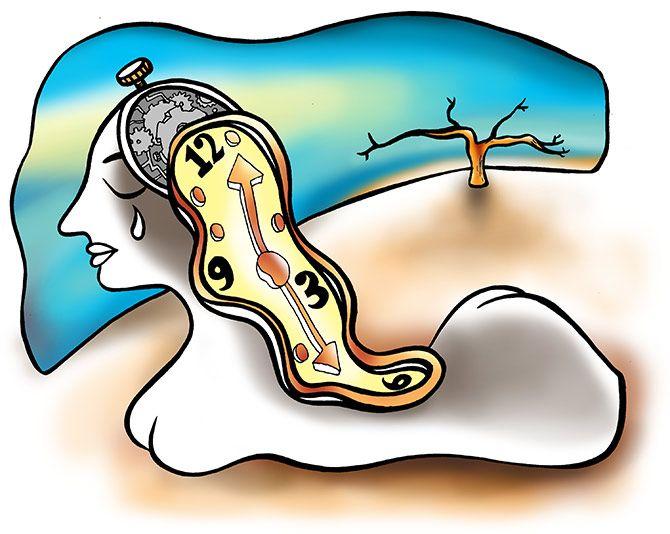
Illustration: Uttam Ghosh/Rediff.com
In the wake of the astonishing feat by Google's AlphaGo machine in defeating, nay thrashing 4-1 the world's best player of Go, it is time for us to wonder what it is that is truly human, that which distinguishes us from the machines.
Deep-learning machines are conquering realm after realm of human expertise, from chess to natural language to Go to other domains, and there is no reason to imagine their progress will come to a halt any time soon.
Some of us may worry that the machines will replace us in more and more jobs; not only the menial, 'dirty, dangerous, difficult' jobs that we don't want to do, but also the ones, including the creative ones, that we like to do.
But is there a difference between Them and Us? I used to think that it was obvious, that they could never be like us, that they were just machines. Now I am not so sure.
I think the only thing that distinguishes us from the machines is memory. It is what makes us human. Memory is so fundamental to us that anything that interferes with it is a great loss. In the Abhijnana Sakuntalam, Dushyanta forgets his beloved Sakuntala, and the epic poem is based on that one fact, and, later, his recovery of that memory. In The English Patient, the most poignant detail is the old, well-thumbed volume of Herodotus that the aviator carries with him, with notes about the woman, not his wife, that he loved.
A person who is suffering from dementia, say Alzheimer's disease, and thus losing their memory, slowly but surely becomes somebody else, not the person that we knew. In a way, we are the sum total of our memories, because the chemicals that we are all made of are very simple and very indistinguishable. It is those electrical impulses in our brains that make us who we are.
I find it striking that the three greatest science fiction films of all time -- and they are genuine classics -- all have as a significant scene or even a theme the issue of memory.
In the brilliant Blade Runner, there is the beautiful Rachel, who doesn't know that she is a cyborg, a Replicant, because she has been implanted with memories borrowed from a young woman, now dead. She thinks she is that person. The Replicants know who they are, the limits to their lives, and they also know that Blade Runners, assassins, are out to kill them. The irony in the film is that the quasi-hero, the Blade Runner Deckard, may himself be a Replicant, and we suspect that because the police chief leaves a hint that he knows Deckard dreams of unicorns. 
But by far the most remarkable scene in the film is the 'tears in rain' monologue when the fugitive cyborg Roy Batty, who is dying, says in what may be the most arresting soliloquy in cinema history:
I've seen things you people wouldn't believe. Attack ships on fire off the shoulder of Orion. I watched C-beams glitter in the dark near the Tannhauser Gate. All those moments will be lost in time, like tears... in rain. Time to die.'
With that magnificent speech, Batty rises above his Replicant-ness, and he is as human, or more human, than any of us. It is hard to watch that scene without a lump in your throat, and Batty, whom we have seen so far as a cold-blooded, dangerous killer, transcends his cyborg nature and transforms himself: Indeed, he becomes the hero of the film.

Fwd: Representations of poverty in the U.S.+Visit expect to sort out Lanka Sino difference+How can Pakistan counter India’s military might+Vietnam protests China’s deployment of drilling rig off the Tonkin Gulf


---------- Forwarded message ----------
From: Sanjeev Nayyar 

Which means even if there is a solution to Kashmir, Pakistan would not be satisfied?
Yes. It's costly for Pakistan to maintain this competition, but they view defeat very differently. They don't view it in terms of territory lost or value of territory or number of lives lost. They view defeat as that moment when they can no longer resist India. They are like an international insurgent.
 
 
3. Sri Lanka Perspectives: March 2016 by R Hariharan 8 April 2016 http://vijayvaani.com/ArticleDisplay.aspx?aid=3915
 
4. Representations of poverty in the U.S. 8.4.16 by s subramaniam http://www.tribuneindia.com/news/comment/deprivation-amid-affluence/219125.html
'Indeed, it turns out that, for the year 2011, if we take the U.S. poverty line to be $7.30 per person per day — a figure which is just one-half of the conservative estimate of $14.60 mentioned earlier — then the number of poor people in the US corresponding to this poverty line is 8.3 million. This is just one instance of the failure to take proper account of the status of the poor when the wealth of a nation is allowed to obscure the deprivation of its poorer members.


My take – My cousin who has lived in the U.S. for over 30 years says travel in the hinterland to see real poverty, do not get swayed by big towns which most Indians visit. Wish the U.S. Churches that remit app a billion dollars every year into India to help poor India focused on the poor back home.


5. Peace process suspended after Yadav arrest 8.4.16 http://tribune.com.pk/story/1080952/ties-with-india-peace-process-seemingly-suspended-after-yadavs-arrest-front-page/ 


6. How can Pakistan counter India's growing military might 8.4.16 by naveen ahmed http://tribune.com.pk/story/1080542/analysis-what-can-pakistan-do-right-in-the-face-of-indias-growing-military-might/

'The $3 billion INS Arihant - strategic vessel that cleared all sea trials is definitely worrisome for Pakistan as it gives Delhi assured second-strike capability in a nuclear standoff.

The current spending of $9.5 billion does not help maintain a balance of power to preserve the status quo. The Modi government has aggressively pursued a policy of encircling and isolating Pakistan. The recent arrests of over a dozen spies allegedly affiliated with RAW have heightened the existing mistrust.


My take – 2 bogies created by the Pakis. One is Yadav arrest. Two is India's growing might. Aggression is the best form of defence mostly Pakistan policy. India has failed to communicate effectively on stockpiling of weapons by Pakistan and Chinese role in Pak Nuclear program.


7. Vietnam protests China's deployment of drilling rig off the Tonkin Gulf 8.4.16 http://english.vov.vn/politics/vietnam-protests-chinas-deployment-of-drilling-rig-off-the-tonkin-gulf-316688.vov

'Commenting on China's construction of a lighthouse on Subi reef in Vietnam's Truong Sa archipelago, the official said, "Once again, Vietnam has sufficient legal and historical evidence of its undisputed sovereignty over the Truong Sa and Hoang Sa archipelagoes. China's action seriously violates Vietnam's sovereignty over Truong Sa, which is illegal and invalid.'


8. Tourist visit S.China Sea islands 7.4.16 http://www.globaltimes.cn/content/977615.shtml

 
9. Visit expect to sort out Lanka Sino difference 7.4.16 http://en.people.cn/n3/2016/0407/c90000-9041389.html
One of the big questions of his tour is whether the two sides will nail the divergences down over the Beijing-funded $1.4 billion port city project in the Sri Lankan capital of Colombo.
 
The scenario drawn out here has relevance because Prime Minister Modi's foreign policy initiatives with regard to Pakistan have so far seemed to oscillate between 'jhappi' (embrace) and 'katti' (estrangement); however, he would need to develop a more centred policy before he travels to Pakistan later this year for the SAARC summit. '
 
Warm Regards
sanjeev nayyar


--
sent from samsung galaxy note3 neo, so please excuse brevity

Fwd: How the Indian liberal is killing Hinduism


---------- Forwarded message ----------
From: S G 


Is the entire definition of liberalism to rest only on the majority faith?

That Charlie Hebdo editorial was Islamophobic paranoia at its extreme. But here's an exercise for you: cut and paste a rough translation of the editorial into your Word document, replace the word *Muslim* and its variations with *Hindu* and its variations and read it. That there staring you in the face is the Indian liberal agenda.
In the last week since I joined a growing chorus of Hindus asking why their temples are being stormed, when Indian law protects against interference on matters of the Waqf board, religious properties of the Church or the Parsis or the Sikhs, I have been called everything from mentally unhinged to bigot and been referred to Modi to get what I want.
Because you see for liberal India, the same who believe the violent acts of rogue terrorists cannot be equated with Islam, even if the perpetrators insist on doing so themselves, the voice of non-violent Hindus who have concerns or fears, and those concerns can always be debated, is always and unequivocally to be equated with violent fascism. Right.
So what has Indian liberalism achieved for Hindus? There are laws that outlaw discrimination on the basis of caste, which is good. New debate suggests outlawing discrimination on the basis of gender, which is good. Temples have been nationalised, lands redistributed and wealth, formed entirely of the private donations of patrons and devotees based on religious needs, audited. Temples are required to indulge in secular development activity.
And as recent outrage shows, choosing not to invite a Muslim DC is now against the principles of templehood. The anti-superstition bill prevents the guileless masses from believing in any unscientific gibberish the priest may throw at them. The Income Tax appellate will not exempt temples as Hinduism is a way of life not a religion, so no excuses there as made in the past, when kings made endowments that were to be used for public good.
The Waqf is also required to use their income for public good, but it is for Muslim public good, not general public good. All great temples for instance offer free food, which is a legacy of the past generosity integral to the religion. And temples are open to all faiths. Dress codes are seen as outrageous.
Though mosques still require you to follow protocol and those demands are seen as culturally appropriate. Temples under state and central government administration are now the personal treasuries of corruption, revenue from lands being used to line the pockets of government officials, and with a paucity of funds for any real research, learning, commentary, thinking or even propagation of actual Hindu texts.
The architectural heritage of the Hindus commands some of the highest prices in the antiquities smuggling market. None of this is unrelated and this is all progressive and great. Hindus should move beyond idol worship anyway.
What makes a temple a place of Hindu worship then? Why is it not, say, a library?
While all of these changes are undeniably progressive, and some such as those against caste discrimination are required to be enforced far more aggressively, no questions asked, with the Maharashtra government bringing in the social boycott bill to reinforce implementation, the question it begs is: Is the entire definition of liberalism to rest only on Hinduism?
Club the above with the fact that there is not a single modern reputed institute of Indic studies in all of India today. The debate over Pollock is also the fear that all academic research on India's Hindu past is only emerging from overseas, and thus leaves the mainstream Hindu thinking with no scholar worthy enough to counter or debunk it - this itself speaks of the lack of institution building.
...deleted